
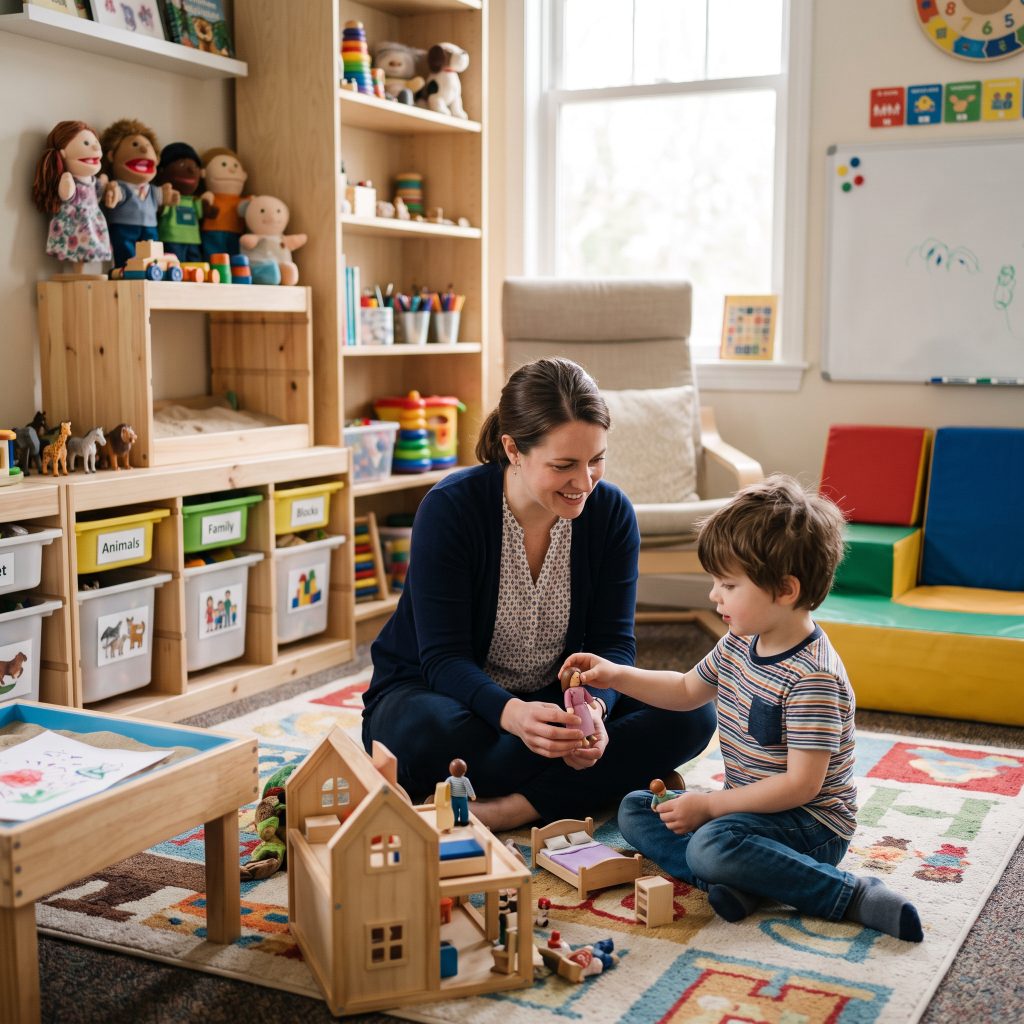
Play therapy is a therapeutic approach that is especially helpful for children. You can use toys, art, games, storytelling and imaginative play to support emotional expression and healing.
Potential benefits of play therapy include:
- Easier emotional expression: Children can communicate experiences and feelings they may not have words for.
- Improved emotional regulation: It can help them recognize, tolerate, and manage strong emotions.
- Processing difficult experiences: Play offers a safer, indirect way to work through trauma, grief, family changes, or stressful events.
- Reduced behavioral and emotional symptoms: It may lessen anxiety, aggression, withdrawal, tantrums, and other difficulties.
- Better coping and problem-solving: Children can practice handling challenges and trying new responses.
- Greater confidence and self-esteem: A supportive, accepting setting can build competence and autonomy.
- Stronger social skills: Play can teach communication, cooperation, boundaries, and conflict resolution.
- Improved relationships: Some approaches involve parents or caregivers and can strengthen attachment and family communication.
- Developmentally appropriate treatment: It meets children at their natural level of communication rather than relying mainly on conversation.
Play therapy is commonly used for anxiety, trauma, grief, behavioral concerns, ADHD-related challenges, adjustment to family changes, illness, transitions and more. Outcomes can vary and it works best with a qualified mental-health professional trained in play therapy. Caregiver involvement is also often important.
Here are 5 Strategies for play therapy:
1.) Try to tune in with the child’s emotions and feelings
When you tune into the child’s state, you are showing them that other people can attune with them. Try to become as attuned as possible with them and match their facial expressions and body language. Matching them shows that you understand and care. This allows them to see that connections are possible and it also helps them work on their empathy muscle.
2.) Let the child hear your thought process during play
For example, you might say:
“Hmm, this block keeps falling. Maybe I’ll turn it sideways.”
“I wonder where this toy animal wants to go.”
“I’m feeling frustrated, so I’m going to slow down and try again.”
Also try to anticipate what they are going to do next and speak it out loud. Try not to tell them what to do, question how they are playing or correct them. Interact with them by saying things out loud and anticipate what they will be doing next and build connection.
3.) Express and work through feelings
A child might turn fear, anger, sadness, jealousy, or frustration into a character, animal, toy, story, movement, or sound. For example, a child could draw their anger as a monster, make two stuffed animals act out a conflict, or show how anxiety moves in their body. Join with curiosity instead of trying to calm the emotion. Help emotions become visible and playable so children can understand, communicate, and regulate them. It is less about teaching a lesson and more about letting the child encounter the feeling safely through imagination.
4.) Be Flexible
Being flexible means deliberately adjusting how much energy, pressure, speed, emotion, or competitiveness you bring to an activity. The idea is that play works best at the right level of challenge and arousal:
If things feel dull, repetitive, or too easy, then add urgency. Try adding difficulty, movement, competition, risk, or stronger commitment.
If things feel stressful, rigid, overwhelming, or conflict-heavy, slow the pace, lower the stakes, simplify the task, add humor, or take a pause.
By noticing the mood and changing that setting, you can keep yourself and others in a state where curiosity, creativity, connection, and learning remain possible.
For example, during a tense game with a child, dialing down might mean becoming sillier and less focused on winning. During an unenthusiastic brainstorming session, dialing up might mean introducing a time limit or playful challenge. The goal is not always calmness or maximum excitement, but the “sweet spot” where play stays engaging without becoming either boring or overwhelming.
5.) Try story telling and get children to tell stories
To encourage storytelling in play therapy:
Create safety first: Follow the child’s lead, stay warm and nonjudgmental, and don’t pressure them to talk.
Use open invitations:
“Tell me what’s happening here.”
“What happens next?”
“Who is this character?”
“I wonder how they feel.”
Narrate rather than question: “The bear is hiding behind the house,” then pause and let the child elaborate.
Use indirect storytelling: Puppets, dolls, miniatures, drawing, sand trays, or story-completion games can feel safer than speaking personally.
Offer a gentle starter: “Once there was a little fox who had a big problem…” Let the child continue.
Allow silence: These may be part of processing. Avoid correcting, leading, or searching for a disclosure.
Let the child be in control: Stories can remain fictional; don’t insist that characters represent real people.
End with containment: Help the child place toys away, finish the story for today, and transition calmly.